Horror AI Photo Editing Prompts Gemini 2026 | Viral Ideas
Horror AI photo editing has become one of the most creative branches of generative AI art, where imagination is transformed into visually disturbing, cinematic, and hyper-realistic images. With tools like Google Gemini, users can now turn simple text descriptions into terrifying scenes filled with emotional tension, dark aesthetics, and storytelling depth.
Unlike traditional photo editing, where manual design skills are required, AI image generation models use prompt engineering to interpret human language and convert it into detailed visual outputs. This shift has changed how creators, designers, and storytellers build horror-themed visuals for content, branding, and entertainment.
In 2026, horror AI editing is not just about fear—it is about cinematic storytelling, psychological depth, and visual realism powered by AI systems such as diffusion models and multimodal transformers.
What Are Horror AI Photo Editing Prompts?
Horror AI photo editing prompts are structured text instructions given to AI systems like Gemini AI, MidJourney, or Stable Diffusion to generate horror-themed visuals.
These prompts define:
- Subject (ghost, abandoned place, cursed figure)
- Environment (dark forest, hospital, fog city)
- Lighting (low light, neon glow, candlelight shadows)
- Mood (fear, suspense, psychological tension)
- Cinematic style (film grain, DSLR realism, ultra-wide shot)
At the core, these prompts rely on Natural Language Processing (NLP) and text-to-image diffusion models, where the AI interprets semantic meaning and constructs a visual output based on learned datasets.
This makes prompt engineering the most important skill in modern AI image creation.
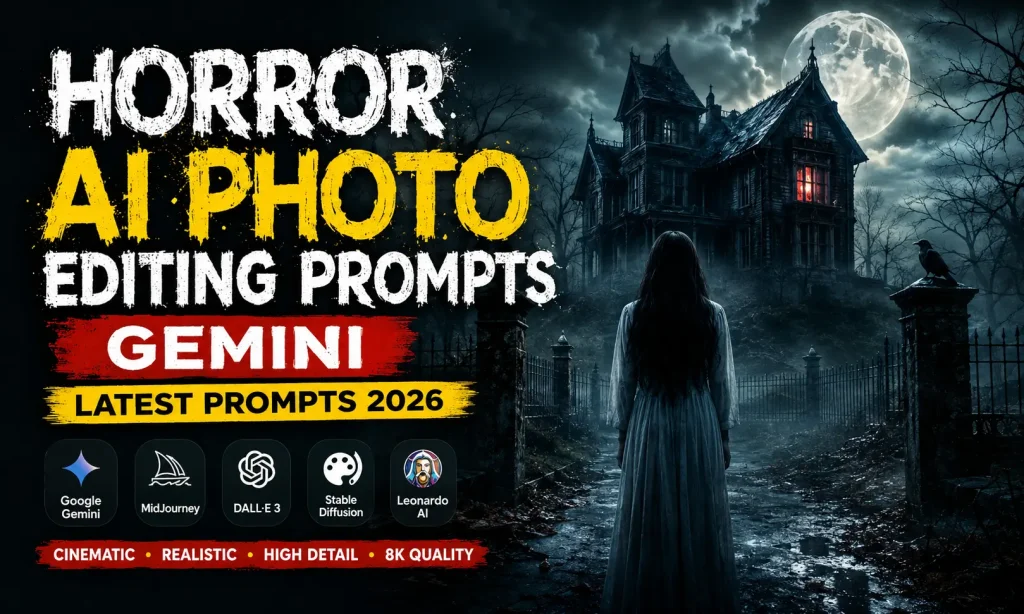
How Google Gemini Creates Horror Images
Google Gemini AI, developed by Google DeepMind, is a multimodal generative model capable of understanding text, images, and contextual meaning together.
In horror image generation, Gemini analyzes:
- Emotional tone of the prompt
- Visual entities like “ghost,” “shadow,” or “abandoned house”
- Environmental conditions such as fog, darkness, or decay
- Cinematic composition instructions
Then it synthesizes a realistic or stylized image using deep generative transformers.
Unlike older models, Gemini focuses on:
- Context-aware generation
- Real-world lighting simulation
- High-detail texture rendering
- Scene coherence and realism
This makes it ideal for creating cinematic horror photography effects that look like real movie stills. Also check: ChatGPT AI Photo Editing Prompts 3 Layer System.
Best Horror AI Photo Editing Prompts
Below are advanced, structured prompts designed for Google Gemini AI image generation.
Abandoned Hospital Horror Scene
A hyper-realistic cinematic horror scene inside an abandoned hospital hallway, broken glass scattered on the floor, flickering fluorescent lights casting unstable shadows, long empty corridor disappearing into darkness, medical equipment rusted and covered in dust, heavy fog filling the lower floor, subtle presence of a shadowy figure at the far end, ultra-detailed textures, DSLR camera perspective, shallow depth of field, 8K resolution, cinematic color grading, horror atmosphere inspired by psychological fear and realism.
Haunted Forest Night Portrait
A young person standing alone in a cursed forest at midnight, surrounded by dense fog and twisted tree branches forming unnatural shapes, glowing red eyes hidden between trees, moonlight partially blocked by clouds, cinematic horror lighting with high contrast shadows, ultra-realistic skin texture, wind blowing through hair, eerie supernatural presence in the background, shot on a 50mm lens, film grain effect, 8K ultra detail.
Ghost Girl in Mirror Reflection
A vintage bedroom with a large broken mirror, dim candlelight flickering on wooden walls, a normal person standing in front of the mirror while the reflection shows a terrifying ghostly girl with hollow eyes and pale skin, distortion effect in mirror glass, cinematic horror lighting, ultra-realistic reflections, dark atmosphere, shallow focus, high detail skin rendering, 8K photorealism.
Cursed Abandoned City
A destroyed modern city covered in fog and darkness, skyscrapers broken and collapsing, empty streets flooded with shallow water reflecting neon lights, ghostly silhouettes walking in distance, cinematic aerial view, stormy sky with lightning, ultra-detailed environment, realistic textures, post-apocalyptic horror atmosphere, 8K resolution, dramatic lighting.
Demonic Presence Bedroom Scene
A dark bedroom at night with a sleeping person barely visible under a blanket, a demonic shadow figure standing near the bed with glowing eyes, heavy darkness blending with smoke-like fog, dim moonlight entering through broken window, cinematic horror composition, ultra-realistic shadows, DSLR quality, emotional fear atmosphere, 8K detail.
Common Mistakes in Horror AI Editing
Many beginners fail to get strong results due to:
- overly short prompts lacking detail
- missing environmental context
- no lighting specification
- unclear subject definition
- ignoring cinematic composition
Strong horror images require structured storytelling inside the prompt, not just random keywords.
Use Cases of Horror AI Generated Images
Horror AI visuals are widely used across digital platforms:
- YouTube horror thumbnails
- storytelling reels and shorts
- movie concept art
- game environment design
- blog feature images
- social media viral posts
These visuals are especially powerful because they trigger emotional engagement and curiosity, which increases CTR and audience retention.
Conclusion
Horror AI photo editing in 2026 is no longer just experimentation—it is a full creative discipline combining prompt engineering, cinematic storytelling, and generative AI systems like Google Gemini.
When you understand how entities like lighting, composition, mood, and environmental storytelling work together, you can create professional-grade horror visuals that look like scenes from real movies.